Thursday, September 30, 2010

Does Your Language Shape How You Think?

"In recent years, various experiments have shown that grammatical genders can shape the feelings and associations of speakers toward objects around them. In the 1990s, for example, psychologists compared associations between speakers of German and Spanish. There are many inanimate nouns whose genders in the two languages are reversed. A German bridge is feminine (die Brücke), for instance, but el puente is masculine in Spanish; and the same goes for clocks, apartments, forks, newspapers, pockets, shoulders, stamps, tickets, violins, the sun, the world and love. On the other hand, an apple is masculine for Germans but feminine in Spanish, and so are chairs, brooms, butterflies, keys, mountains, stars, tables, wars, rain and garbage. When speakers were asked to grade various objects on a range of characteristics, Spanish speakers deemed bridges, clocks and violins to have more “manly properties” like strength, but Germans tended to think of them as more slender or elegant. With objects like mountains or chairs, which are “he” in German but “she” in Spanish, the effect was reversed.

In a different experiment, French and Spanish speakers were asked to assign human voices to various objects in a cartoon. When French speakers saw a picture of a fork (la fourchette), most of them wanted it to speak in a woman’s voice, but Spanish speakers, for whom el tenedor is masculine, preferred a gravelly male voice for it. More recently, psychologists have even shown that “gendered languages” imprint gender traits for objects so strongly in the mind that these associations obstruct speakers’ ability to commit information to memory."

from an article by Guy Deutscher in The New York Times

Monday, September 27, 2010

This is a news website article about a scientific paper

In the standfirst I will make a fairly obvious pun about the subject matter before posing an inane question I have no intention of really answering: is this an important scientific finding?


In this paragraph I will state the main claim that the research makes, making appropriate use of "scare quotes" to ensure that it's clear that I have no opinion about this research whatsoever.

In this paragraph I will briefly (because no paragraph should be more than one line) state which existing scientific ideas this new research "challenges".

If the research is about a potential cure, or a solution to a problem, this paragraph will describe how it will raise hopes for a group of sufferers or victims.

This paragraph elaborates on the claim, adding weasel-words like "the scientists say" to shift responsibility for establishing the likely truth or accuracy of the research findings on to absolutely anybody else but me, the journalist.

[...]

http://www.guardian.co.uk/science/the-lay-scientist/2010/sep/24/1

Sunday, September 26, 2010

Blogging Is Alive and Well, Says Report

By FREDERIC LARDINOIS of ReadWriteWeb
Published: September 24, 2010

While blogging was still a major topic of discussion just a few years ago, things have been rather quiet around it in recent times. Even in the so-called blogosphere, we don't talk a lot about the actual activity of blogging anymore these days. According to a new report from research firm eMarketer, however, blogging is still alive and well. Today, half of all Internet users read blogs and and while blogging itself remains somewhat of a niche activity, about 12% of U.S. Internet users update a blog at least once per month.

http://www.nytimes.com/external/readwriteweb/2010/09/24/24readwriteweb-blogging-is-alive-and-well-says-report-17921.html?ref=technology

Get a Clue: What Do People Remember About Your Site?

September 24, 2010
By FREDERIC LARDINOIS of ReadWriteWeb

You've invested good money in your web design, but do you know what your customers actually remember about your site? Clue, a new tool from Bay Area interaction design and design strategy firm ZURB, lets you create a 5-second interactive memory test that you can use to test what people remember about your product. The tool is available for free and you don't even have to log in to use it.

In a 5-second test, you get to see a website for 5 seconds and then you have to enter up to five things you remember about the screenshot you just saw. These tests are pretty common in usability studies and ZURB isn't the first company to offer a web-based version of this. FiveSecondTest.com, for example, offers more features than Clue, but it's also a paid service.

With Clue, ZURB focused on making the creating of these test as easy to use as possible. To get started, you just have to enter the URL of the site you want to test. Clue will take a screenshot of the site and return a link that you can then give to your test subjects. As ZURB's lead marketer Dimitry Dragilev told us, the tool is mainly aimed at small businesses and mom and pop stores, as well as designers who want to quickly test and idea. Given that you can't password-protect your test results, though, you probably don't want to use it for confidential tests.

Once you know what your visitors remember about your site, you can then work on tweaking your site to match what you actually want them to remember about you and your product.

Clue joins ZURB's constantly expanding range of tools like Bounce (our review), Notable and Verify.

http://www.nytimes.com/external/readwriteweb/2010/09/24/24readwriteweb-get-a-clue-what-do-people-remember-about-you-3556.html?ref=technology

Friday, September 24, 2010

The Future of the Book.

The Future of the Book. from IDEO on Vimeo.


"Meet Nelson, Coupland, and Alice — the faces of tomorrow’s book. Watch global design and innovation consultancy IDEO’s vision for the future of the book. What new experiences might be created by linking diverse discussions, what additional value could be created by connected readers to one another, and what innovative ways we might use to tell our favorite stories and build community around books?"

Tuesday, September 21, 2010

3 Scholars Take On the Business of Book Publishing

Like West Virginia's, the press at Texas Christian University is a small operation. It aims to publish about 20 books a year and has a staff of three people, including Mr. Williams, who handles acquisitions and oversees all operations.

He has been given a three-year window to develop the press, which he says already breaks more or less even. "My main task is to keep the press healthy, try to reduce costs to the university, and look toward the future," he said.

High on Mr. Williams's agenda is making the press more visible to the rest of the university community. "There's not a lot of students and faculty who really know a lot about TCU Press," he said. So he's holding meetings around campus to talk about possible publishing partnerships, student internships, and other ways in which the press can strengthen its home ties.

Then there's the awesome challenge of the digital age to navigate. "We ­really need to be cognizant of this tremendous revolution that's going on right now, not only in the publishing industry but in the entire concept of literacy," Mr. Williams said.

He will push ahead to convert the press's backlist into e-books and "basically try to do what a number of the healthy academic presses in the country are already doing," he said.

Having studied earlier cycles of publishing upheaval and transformation, Mr. Williams sounds intellectually well positioned to lead a press through the current one. "There are a number of really interesting parallels that can be drawn to the revolution in print culture that occurred in the 18th and early 19th centuries and the kind of revolutions going on today," he said. Print culture—presses, newspapers, readership—exploded in the 19th century. "Similar kinds of explosions are taking place today with the revolution in technology," he said. "I think it's fascinating."

http://chronicle.com/article/Scholars-Take-On-the-Business/124520/

Sunday, September 19, 2010

Intel wants to charge $50 to unlock stuff your CPU can already do

Hold onto your hyperthreaded horses, because this is liable to whip up an angry mob -- Intel's asking customers to pay extra if they want the full power of their store-bought silicon. An eagle-eyed Engadget reader was surfing the Best Buy shelves when he noticed this $50 card -- and sure enough, Intel websites confirm -- that lets you download software to unlock extra threads and cache on the new Pentium G6951 processor. Hardware.info got their hands on an early sample of the chip and discovered it's actually a full 1MB of L3 cache that's enabled plus HyperThreading support, which translates to a modest but noticeable upgrade. This isn't exactly an unprecedented move, as chip companies routinely sell hardware-locked chips all the time in a process known as binning, but there they have a simpler excuse -- binned chips are typically sold with cores or cache locked because that part of their silicon turned out defective after printing. This new idea is more akin to video games that let you "download" extra weapons and features, when those features were on the disc all along. Still, it's an intriguing business model, and before you unleash your rage in comments, you should know that Intel's just testing it out on this low-end processor in a few select markets for now.

from: Engadget

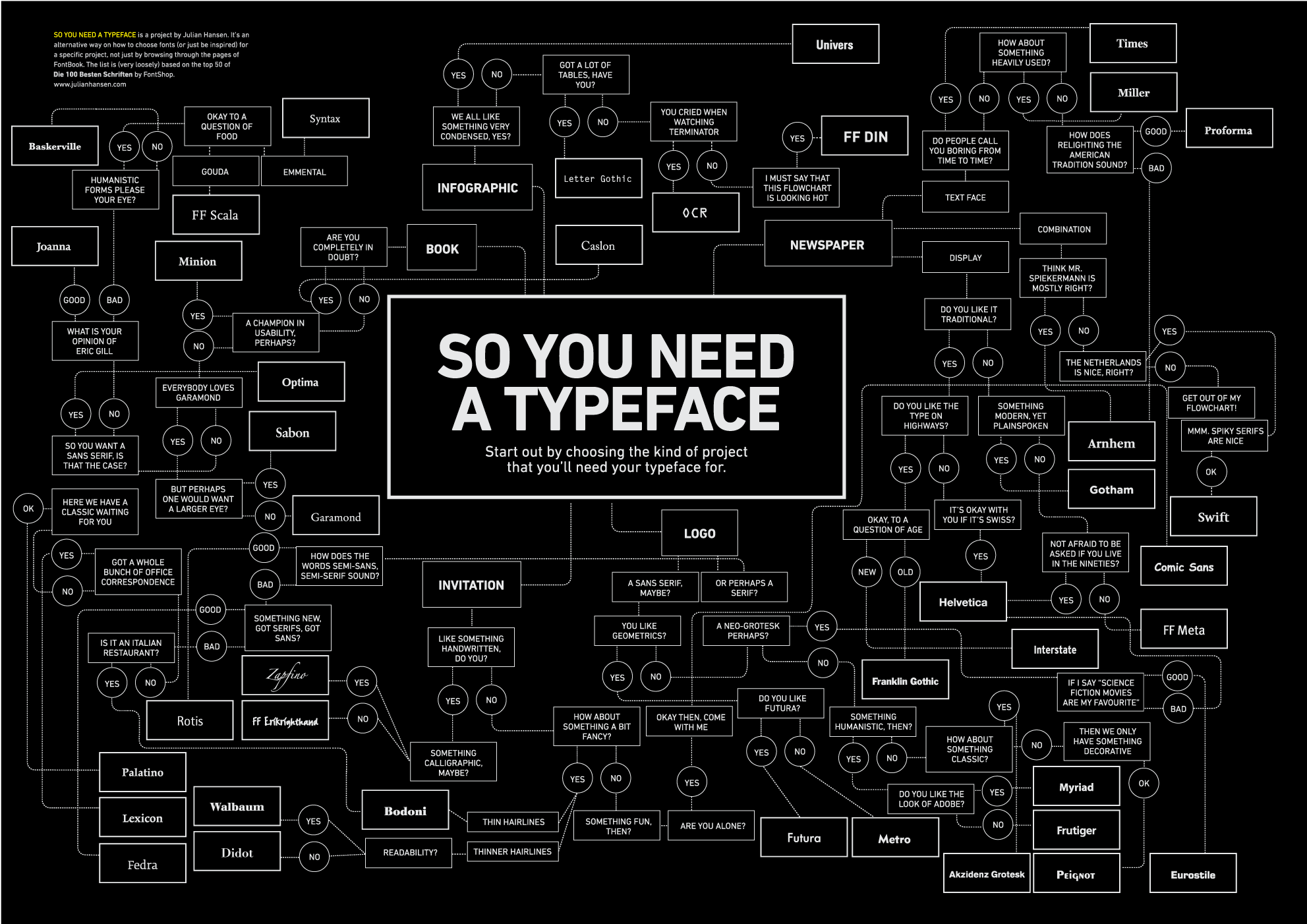
So, you need a typeface?

Thursday, September 16, 2010

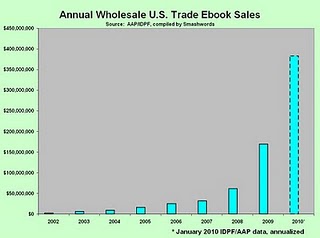
Ebook market exploding, says new iDPF survey

idpf2010.jpg

What you see from my chart is that ebook sales grew nicely between 2002 and 2007, but were really too small to register on the radar screens of most industry watchers. Starting in 2008, however, the growth rate started to accelerate, and then this acceleration continued throughout 2009 and into the first month of 2010.
According to the AAP, in 2009 ebooks accounted for 3.31% of all trade book sales, up from only 1.19% in 2008. Even if sales stay flat from January onward in 2010, we’re looking at ebooks accounting for 6-8% of U.S. book sales in 2010. If sales accelerate further, a 10% monthly run rate is certainly likely by the end of this year. These numbers are dramatically higher than most reasonably-minded industry watchers predicted even a few months ago.

http://www.teleread.com/ebooks/ebook-market-exploding-says-new-idpf-survey/

Wednesday, September 8, 2010

Of Two Minds About Books

By the end of this year, 10.3 million people are expected to own e-readers in the United States, buying about 100 million e-books, the market research company Forrester predicts. This is up from 3.7 million e-readers and 30 million e-books sold last year.

The trend is wreaking havoc inside the publishing industry, but inside homes, the plot takes a personal twist as couples find themselves torn over the “right way” to read. At bedtime, a couple might sit side-by-side, one turning pages by lamplight and the other reading Caecilia font in E Ink on a Kindle or backlighted by the illuminated LCD screen of an iPad, each quietly judgmental.

Although there are no statistics on how widespread the battles are, the publishing industry is paying close attention, trying to figure out how to market books to households that read in different ways. 

http://www.nytimes.com/2010/09/02/technology/02couples.html?src=me&ref=technology

Tuesday, September 7, 2010

Clay Shirky: How cognitive surplus will change the world

Is Google Making Us Stupid?

"I can feel it, too. Over the past few years I’ve had an uncomfortable sense that someone, or something, has been tinkering with my brain, remapping the neural circuitry, reprogramming the memory.

My mind isn’t going—so far as I can tell—but it’s changing. I’m not thinking the way I used to think. I can feel it most strongly when I’m reading. Immersing myself in a book or a lengthy article used to be easy. My mind would get caught up in the narrative or the turns of the argument, and I’d spend hours strolling through long stretches of prose. That’s rarely the case anymore. Now my concentration often starts to drift after two or three pages. I get fidgety, lose the thread, begin looking for something else to do. I feel as if I’m always dragging my wayward brain back to the text. The deep reading that used to come naturally has become a struggle."

Nicholas Carr, From _The Atlantic_